Masud Pathik, PhD

Poetry

His first book of poems appeared in 1996. Almost all of what followed is rooted in the paddy field, the farmer and the language of the people who work the land.

Really, there is no such thing as personal achievement. Nor is there anything universal. It is all untrue: the idea of a myth.

Life’s one real achievement is the moment. To live counting moments, and to die quickly, is the achievement no one escapes.

And still, man is just a concept.

Masud Pathik

Outside the institution

After my first book, Krishokful, came out in 1996, I turned away from the institution. With friends from the university I joined the anti-establishment literary movement, and for eleven years I published no book and sent nothing to the daily papers. We made our own little magazines instead : Bratya, Anticlock, Revive, Coffin Tract. Bratya was mine. The name never left me; it is still the name of my company.

We kept a reading circle, Nandipath, and met in it again and again. We read philosophy, history, anthropology and poetry, whatever we could carry. Kallol was in that room, and Kolkata's Hungry Generation, Malay and Samir Roychoudhury, Shaileshwar Ghosh. So were the Beats, Burroughs and Kerouac, and Bob Marley's Rastafari. I learned more in that circle than in any classroom.

It taught me what I still believe. Art is not for art's sake. Beauty has to come from a context that holds collective thought, from the land and from the people pushed off it. I wanted a sentence that gives a jolt, a syntax that lets English and other tongues walk into a Bengali line. In 2007 I began to publish again. I never really left that circle.

Masud Pathik
Poems in English

I begin with what is there, and I do not soften it. Then the frame breaks: a dead river walks in and speaks, the god of death comes in with a kettle of tea and his face is my face. Nobody in the poem is surprised, and that is the argument. In a country where the land disappears overnight and comes back somewhere else, the impossible is a form of accurate reporting.

10 of 50 poems translated. New translations are added here as each one is finished.

Land, water and paddy

Eco-poetry: the field, the river and the market that buys both.

The self, alone

Existential poems: hunger, separation, and the freedom of having no one.

Where the frame breaks

Surreal and magic-real poems: a dead river speaks, Yama brings tea.

Village philosophy

Plain truths in a farmer's voice, and the state's English arriving mid-line.

English words that appear in the Bengali originals, such as content hour or ethical imagery, are kept and set in italic. Bengali words with no English equivalent, such as beel, haor and panta, are kept and explained under each poem.

On the poetry

Reviews and critical writing on the poetry will be collected here.

Books

Poetry since 1996, almost all of it rooted in the paddy field, the farmer and the language of the people who work the land. English titles are translations.

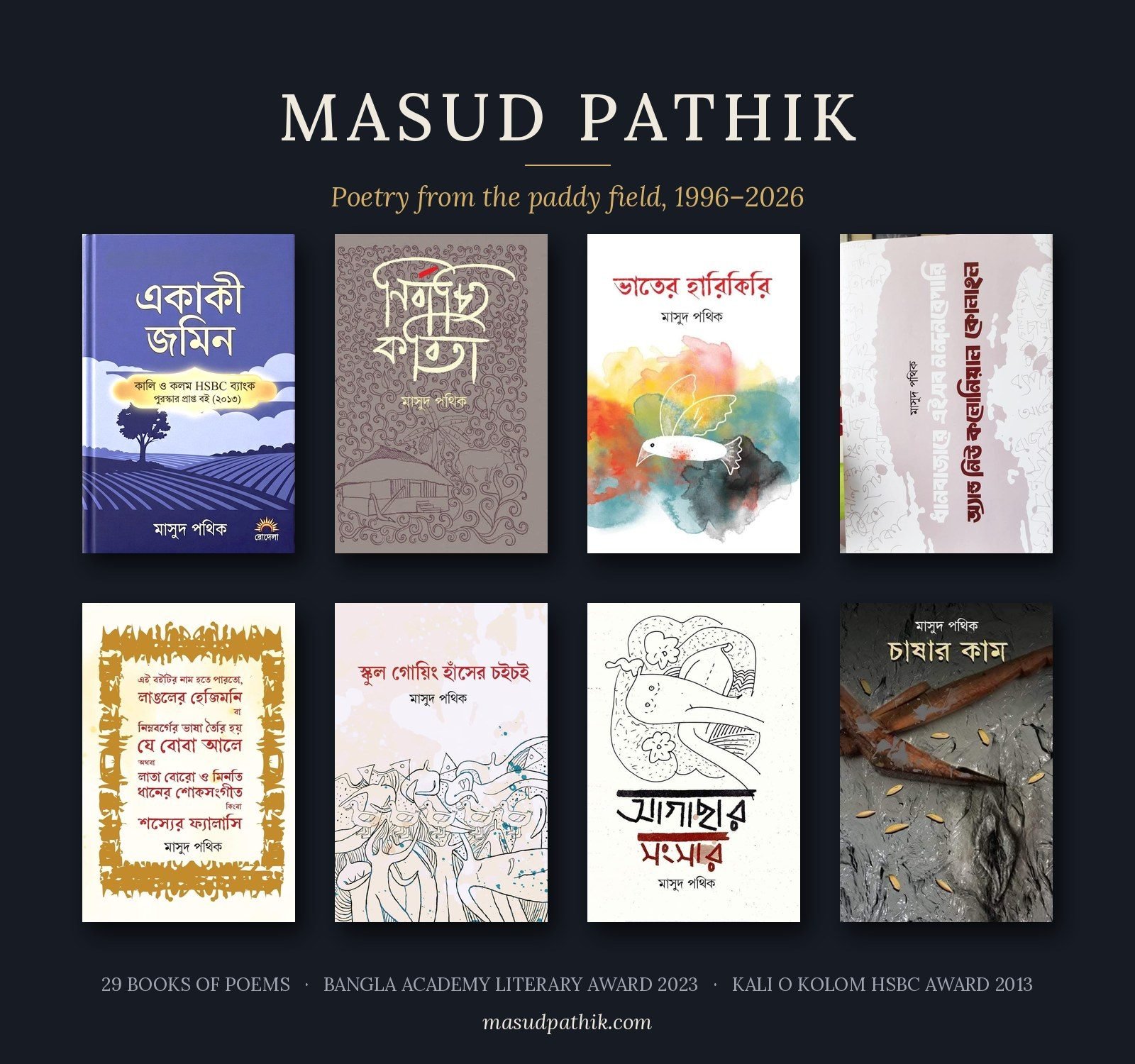
Eight covers of Masud Pathik’s books of poems, among them Ekaki Jomin, Bhater Harakiri and Agachhar Songshar

Poetry

  1. Nirbachito Premer Kobita Selected Love Poems. Boiwala Book Café, Kolkata and Santiniketan, 2026
  2. Agachhar Songshar A Household of Weeds. Srot Prokashon, Agartala, Tripura, 2024
  3. Ei Boitir Nam Hote Parto… This Book Could Have Been Called… (The Fallacy of Grain). Bratya Creation, 2024
  4. Chashar Colony The Farmers’ Colony. Jagotik, Ekushey Book Fair, 2024
  5. Kadar Kolorob The Clamour of Mud. Bratya Creation, 2022
  6. Bhater Harakiri The Harakiri of Rice. Palok Publishers, Kolkata Book Fair, 2022
  7. Dhanbazare Eishob Nandan-Bepari and New Colonial Kolahol These Merchants of Beauty in the Paddy Market, and the New Colonial Clamour, 2022
  8. Pagoler Budbud The Madman’s Bubbles. Pankouri Prokash
  9. Kannar Kunaghor The Corner Room of Weeping, 2021
  10. Chashar Kam The Farmer’s Work. Bratya Creation, 2020
  11. Onahari Dhulogon The Hungry Dust, 2019
  12. Shadher Lau The Cherished Gourd, 2019
  13. Ghamer Mokam The Market of Sweat, 2018
  14. Amon Aush Dui Bon Aman and Aush, Two Sisters, or Commodity, or Nature and Whatever Else
  15. Batasher Bijtola The Seedbed of the Wind, 2018
  16. Dadar Khorom Grandfather’s Wooden Sandals, 2017
  17. Langoler Bhubon The World of the Plough, 2017
  18. Shapla: Joler Jonmondho Meye Water Lily: The Water’s Daughter, Born Blind, 2016
  19. Chashar Bochon The Farmer’s Sayings, 2016
  20. Rollcaller Baire Theke Jenechi Ei Krishak-Jonmer Curriculum From Outside the Roll Call I Learned the Curriculum of a Peasant Birth, 2015
  21. Chashar Put The Farmer’s Son. Pathak Samabesh, Dhaka, 2014
  22. Ekaki Jomin Solitary Land. Rodela, 2013. Kali o Kolom HSBC Award
  23. Mather Kol The Lap of the Field, 2012
  24. Harer Pakhali The Bone Bird, 2011
  25. Dhanchor The Paddy Thief, 2010
  26. Setu Harabar Din The Day the Bridge Was Lost, 2009
  27. Dhaner Grivar Niche Kichu Obhiman Some Grievance Beneath the Neck of the Paddy, 2008
  28. Batasher Bazar The Market of the Wind, 2007
  29. Krishakphul The Farmer’s Flower, 1996. His first book

Coming

  • Nirbachito Kobita Selected Poems, 2026
  • Kobita Songroho 01 Collected Poems, Volume One, 2027

Manuscripts

  • Echo Chamber
  • The Hegemony of the Plough
  • An Elegy for Lata, Boro and Minoti Paddy
  • The Mute Ridge Where Subaltern Language Is Made (Subaltern series)
  • The Viral Version of the Village, or Whatever Else Will Be Written About Villages
  • The Quack-Quack of School-Going Ducks
  • Sitting on the Ridge of a Paddy Field, I Talk to Myself

On cinema

  • Music in the Films of Ritwik Ghatak: The Context of Partition. PhD thesis, Assam University, 2022
  • New Cinema and the Raw Realism Movement
  • Screenplays with reviews: Nekabborer Mohaproyan, Maya: The Lost Mother, Soul of Nature: BOK, Street Philosopher, Old Is Alone
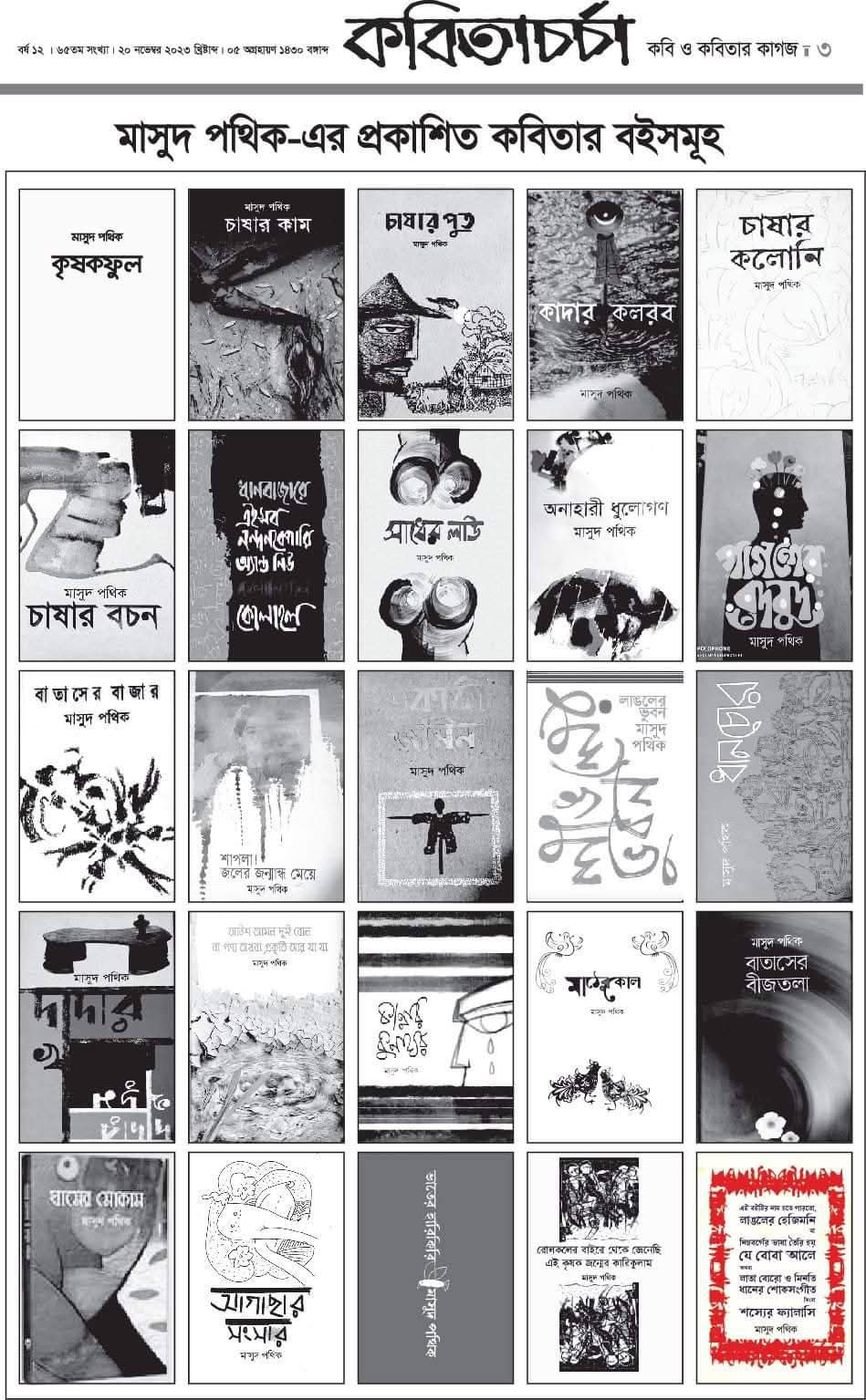
A page of Kobitacharcha showing the covers of Masud Pathik’s published books of poems
His published books of poems, as printed in Kobitacharcha, 20 November 2023.
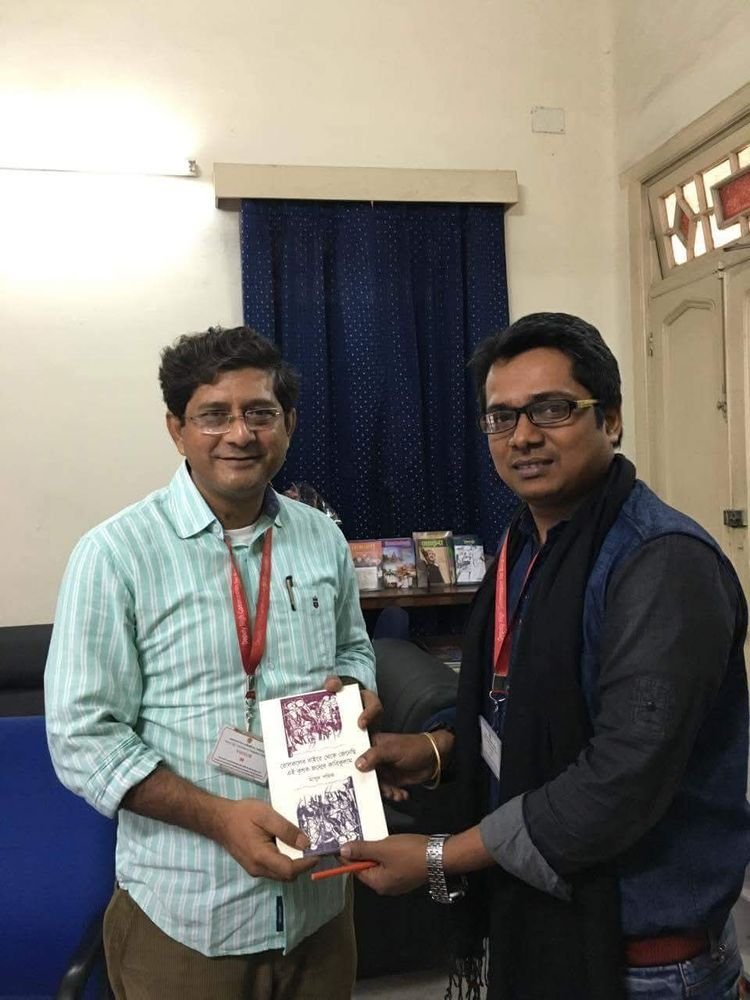
Masud Pathik presenting a copy of his book to a fellow writer
Presenting Rollcaller Baire Theke Jenechi Ei Krishak-Jonmer Curriculum.

Earlier books are sold at Aziz Market in Shahbag, and at Concord, Ujan, Koyekjon and Pathak Samabesh in Dhaka; some in Kolkata, Tripura and online.